Sports Event
6.6 Million Train Martial Arts. Twin Falls Has No Public Gym.
TL;DR:
The U.S. martial arts industry has 6.6 million active participants, over 50,000 studios, and $19.4 billion in annual revenue. Brazilian jiu-jitsu alone has seen search interest double in the past decade, making it the fastest-growing single martial art in America. The largest age group in martial arts is 7 to 12 year olds, and parents spend $100 to $300 per month per child at private studios. A community recreation center can offer affordable martial arts classes, youth development programs, and small community tournaments using the same gymnasium floor that hosts wrestling, basketball, and every other sport the proposed Twin Falls facility is designed for. Right now, Twin Falls families who want martial arts training pay private studio rates or go without.
The tournament and programming conversation for the Twin Falls recreation center has covered basketball, volleyball, pickleball, wrestling, indoor soccer, cheerleading, and badminton. Each serves a different community. None of them addresses the category of athletic discipline that 6.6 million Americans actively practice and that parents consistently cite as one of the most valuable investments in their children's development.
Martial arts is not just a sport. For millions of American families, it is the activity they trust most to build discipline, confidence, and physical fitness in their kids. And in Twin Falls, the only way to access it is through a private studio at private studio prices.
A $19.4 billion industry built on youth development
The scale of martial arts in America is larger than most people realize.
According to industry data compiled by Wellyx, 6.6 million Americans actively participated in martial arts as of 2023. More than 50,000 studios operate nationwide. The U.S. martial arts market reached an estimated $19.4 billion in revenue in 2024, and the global industry is projected to reach $170 billion by 2028.
The largest single age group in martial arts is 7 to 12 year olds, representing 26 percent of total membership across all disciplines. The second largest is 25 to 34 year olds at 21 percent. Participation is roughly 60 percent male and 40 percent female, with women's enrollment growing rapidly, particularly in Brazilian jiu-jitsu and kickboxing.
Among individual disciplines, Brazilian jiu-jitsu is the fastest-growing martial art in America. Google search interest in BJJ has increased 104 percent over the past two decades. An estimated 750,000 Americans now practice BJJ, with 6 million practitioners worldwide. The sport's growth has been driven by the popularity of MMA and the UFC, which brought grappling disciplines into mainstream awareness.
Taekwondo and judo, both Olympic sports (taekwondo since 2000, judo since 1964), maintain large established participation bases with structured youth competition pathways. Karate, which entered the Olympic program in 2021, remains one of the most widely practiced martial arts globally.
What all of these disciplines share is a youth development emphasis that sets martial arts apart from conventional team sports. The focus on personal discipline, respect, self-regulation, and incremental skill progression (the belt system) is why parents consistently rank martial arts among the most valuable activities they enroll their children in.
What parents are paying at private studios
Martial arts instruction is almost entirely delivered through private studios in most American cities, and the cost reflects that.
Industry data shows parents spend $100 to $300 per month per child on martial arts classes at private studios. That translates to $1,200 to $3,600 per year per child before equipment, testing fees, tournament entry, and uniform costs. For families with multiple children training, annual costs can reach $5,000 to $10,000.
For context, the median household income in Twin Falls is roughly $61,205. A family earning that amount and spending $200 per month on one child's martial arts training is allocating nearly 4 percent of gross household income to a single extracurricular activity.
That price point is not a criticism of private studios. They provide expert instruction, dedicated facilities, and structured curricula. But it means that martial arts, like competitive cheerleading and club volleyball, is increasingly an activity available only to families who can absorb that cost. The income gap in youth sports participation, which widened to 20.2 percentage points in 2024, applies to martial arts as directly as it applies to any other sport.
A community recreation center provides the second tier of access that Twin Falls currently lacks: affordable, introductory martial arts programming that serves families at every income level.
What martial arts looks like at a recreation center
Martial arts at a community recreation center is not a replacement for a dedicated private studio. It is the entry point that feeds the entire martial arts ecosystem. Here is what it typically looks like.
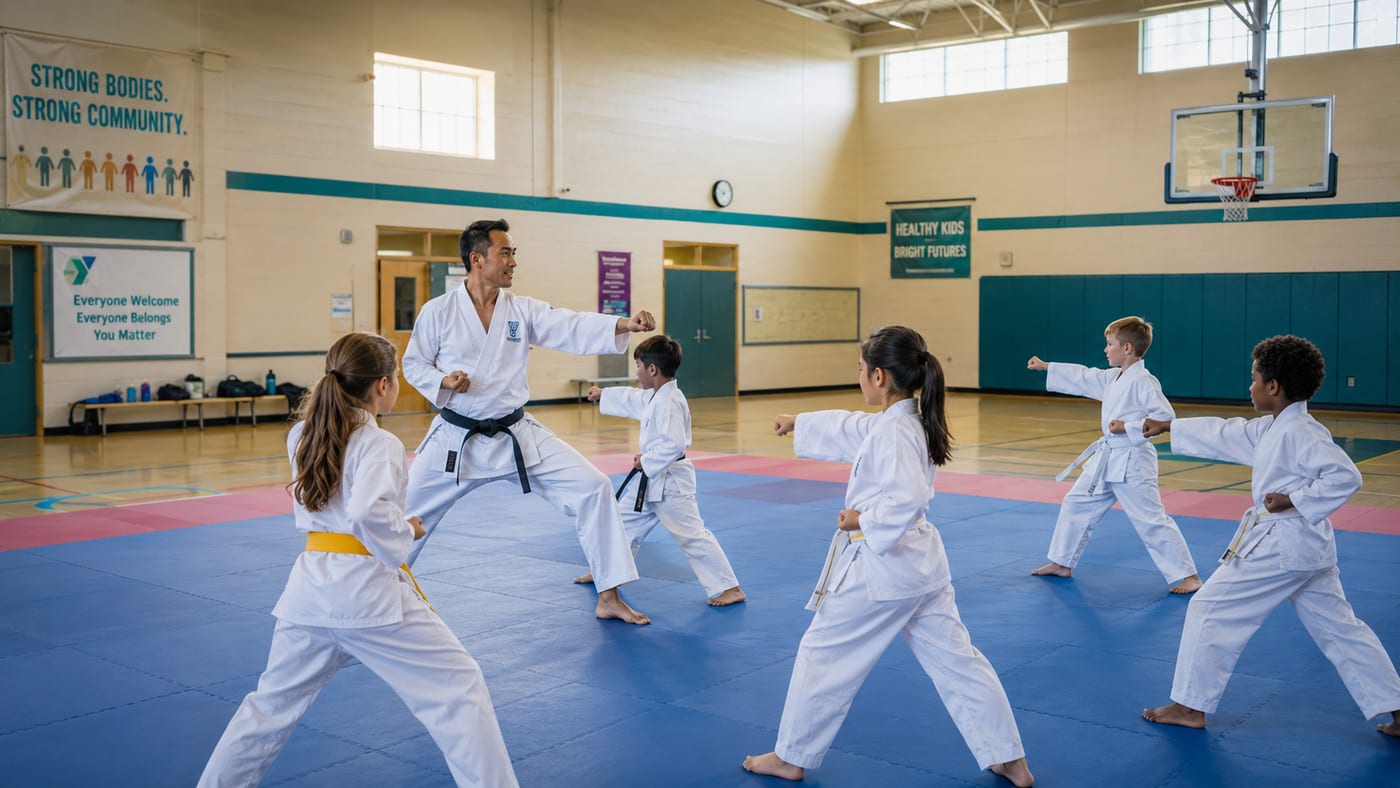
Youth martial arts classes. Multi-week sessions teaching fundamental skills in one or more disciplines: basic taekwondo forms, introductory judo throws and falls, beginning BJJ ground control, or a blended martial arts curriculum covering striking, grappling, and self-defense basics. Sessions run six to eight weeks, meet once or twice per week, and cost a fraction of private studio tuition. Age groups are typically 4 to 6, 7 to 10, and 11 to 14. No prior experience required.
Adult classes. Introductory BJJ, self-defense workshops, and martial arts fitness sessions for adults who want to train without committing to a private studio membership. Evening and weekend scheduling accommodates working adults.
Family classes. Sessions where parents and children train together. Martial arts is one of the few athletic activities where a parent and a child can practice the same skills side by side, at their own levels, in the same room. This format builds household engagement and is a strong retention driver for recreation center programming.
Summer and school-break camps. Week-long martial arts camps during summer, spring, and winter breaks. These combine physical training with the discipline and character development elements that parents value most. They fill the same break-week programming gap that every other rec center sport addresses.
Small community tournaments and exhibitions. Once regular programming is established, a recreation center can host local martial arts events: grappling tournaments with 20 to 40 participants, taekwondo sparring exhibitions, belt promotion ceremonies open to families, and inter-program friendly competitions between rec center martial arts classes and local private studios.
These events are Saturday affairs, community-scale, and family-oriented. They use the same gymnasium floor that hosts wrestling tournaments (mats on the gym floor for BJJ and judo) or open floor space for taekwondo and karate. The proposed Twin Falls recreation center's multi-court gymnasium accommodates all of these formats without any specialized construction.
What makes martial arts different from every other rec center sport
Every sport in the Twin Falls tournament series serves athletes in a team context. Basketball needs five. Volleyball needs six. Even wrestling, the most individual of the group, competes within a team dual-meet structure.
Martial arts is fundamentally individual. A single child can walk into a recreation center martial arts class on any Tuesday, with no prior experience, no team tryout, no seasonal registration deadline, and no requirement to find four other kids to fill a roster. She trains at her own pace, earns belts on her own timeline, and competes (if she chooses to) as an individual.
That accessibility matters for kids who do not thrive in team sport environments. Not every child wants to play basketball. Not every child is wired for the social dynamics of a volleyball team. Some children, particularly those dealing with anxiety, low confidence, or social challenges, flourish in an environment where the only person they need to beat is the version of themselves from last week. Martial arts provides that environment structurally.
The mental health case for a recreation center documented Idaho's behavioral health crisis and the role of physical activity in addressing it. Martial arts adds a layer that general fitness programming cannot: the discipline framework (respect, focus, self-control, perseverance) is built into every class, not as an afterthought but as the foundation of the practice.
The private studio pipeline
Recreation center martial arts programming does not compete with private studios. It feeds them.
A child who takes an introductory judo class at the rec center for $40 over six weeks may discover a passion for the sport and eventually enroll at a private studio for more advanced, intensive training. That child would never have found martial arts at all without the affordable, low-commitment entry point the rec center provided.
This is the same relationship that exists between rec center basketball leagues and competitive travel basketball, or between rec center swim lessons and club swim teams. The recreation center serves as the discovery layer. Private providers serve as the development layer. Both benefit when the entry point exists.
In Twin Falls, private martial arts studios would gain a broader pool of interested, fundamentally trained young athletes if the rec center offered introductory programming. The two models are complementary, not competitive.
What the facility needs
Martial arts programming uses spaces the proposed Twin Falls rec center already includes.
BJJ and judo classes require mats on a gymnasium floor, the identical setup used for wrestling. Taekwondo and karate classes require open floor space, either on the gymnasium hardwood or in a multipurpose room. No permanent infrastructure, no specialized flooring, and no dedicated dojo is needed. Mats roll out for grappling classes and roll back up when the floor is needed for basketball or volleyball.
Small community tournaments use the same configuration. Mats go down for a Saturday BJJ event the same way they go down for a wrestling invitational. Open floor space hosts a taekwondo sparring exhibition the same way it hosts a cheer showcase.
The facility's multipurpose rooms provide additional capacity for smaller classes, breakout sessions, and warm-up areas during events. The combination of gymnasium and multipurpose space is all martial arts programming requires.
Where the conversation stands
A recreation center committee within the Twin Falls Parks and Recreation Department has been studying this question since 2017. In June 2025, the City Council voted to advance the long-stalled feasibility study. Parks and Recreation Director Wendy Davis said the council's vote "breathed a little bit of life into what I thought was a dying initiative."
A grassroots advocacy campaign has proposed naming a potential facility after U.S. Army Specialist Troy Carlin Linden, a soldier with the 54th Engineer Battalion who was killed in action on July 8, 2006, in Ar Ramadi, Iraq. The proposal comes from a Twin Falls resident who served in the same unit.
Closing
Martial arts is a $19.4 billion American industry with 6.6 million active participants. It is the activity parents most consistently associate with building discipline, confidence, and resilience in their children. BJJ alone has doubled in interest over the past decade. Taekwondo and judo are Olympic sports with established youth pathways. And the largest age group in martial arts nationwide is 7 to 12 year olds.
In Twin Falls, the only access point is a private studio at $100 to $300 per month. A recreation center would add the affordable, introductory tier that makes martial arts accessible to every family in the Magic Valley, not just the ones who can absorb private studio costs.
The gymnasium floor that hosts basketball, volleyball, wrestling, and futsal is the same floor that hosts a Tuesday evening youth judo class and a Saturday morning community grappling tournament. One building. One more sport. One more community served.
Frequently Asked Questions
How popular is martial arts in the United States? There are 6.6 million active martial arts participants in the U.S., with over 50,000 studios nationwide. The industry reached $19.4 billion in revenue in 2024. The largest participant age group is 7 to 12 year olds, representing 26 percent of total membership.
What is the fastest-growing martial art? Brazilian jiu-jitsu. Google search interest in BJJ has increased 104 percent over the past two decades. An estimated 750,000 Americans now practice BJJ, driven largely by the popularity of MMA and the UFC.
How much do private martial arts classes cost? Parents typically spend $100 to $300 per month per child at private studios. That translates to $1,200 to $3,600 per year before equipment, testing fees, and tournament costs.
What would martial arts at a rec center cost? Recreation center martial arts classes typically run $30 to $60 for a six-to-eight-week session, a fraction of private studio tuition. The programming is designed as an affordable introductory entry point, not a replacement for advanced training at private studios.
What martial arts can be taught in a rec center gymnasium? BJJ and judo use mats on the gymnasium floor (same setup as wrestling). Taekwondo and karate use open floor space. All formats work in a standard multi-court gymnasium or multipurpose room without specialized construction.
Would rec center martial arts classes compete with local private studios? No. Recreation center programming serves as an entry point that feeds the private studio pipeline. Children who discover martial arts through an affordable rec center class often go on to enroll at private studios for advanced training. The two models are complementary.
Is Twin Falls actively considering a recreation center? A city committee has been studying the question since 2017. In June 2025, the City Council voted to advance the feasibility process. No specific site, cost, or funding mechanism has been finalized as of this writing.
Where can residents follow the conversation? Twin Falls City Council meetings are open to the public, and the Parks and Recreation Department posts updates on the city's official website. A community advocacy group is also tracking the issue at twinfallsreccenter.com.