Rec Center
One Building, Eleven Sports, Twelve Months. Zero Dark Weeks.
TL;DR:
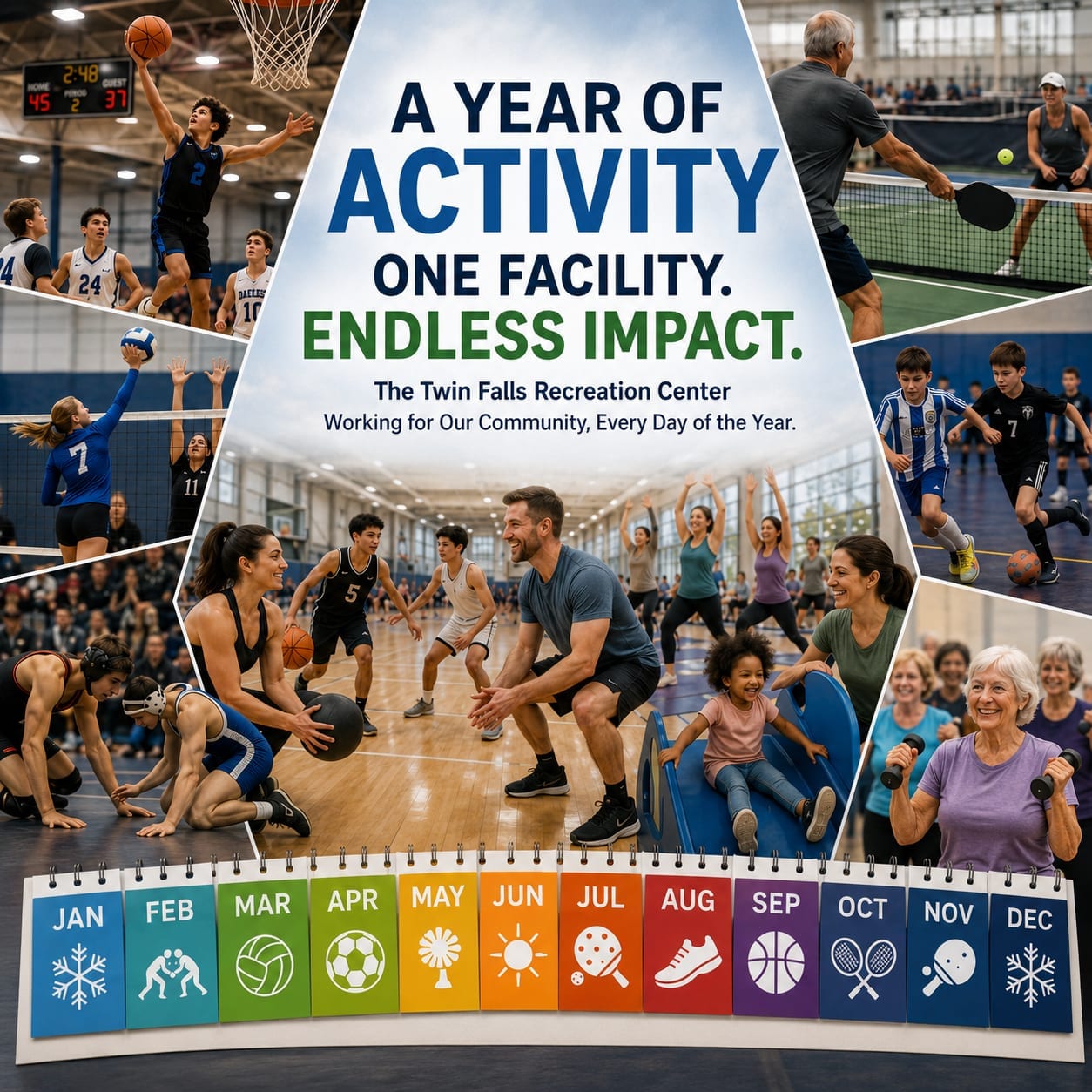
The Twin Falls recreation center conversation has made individual cases for basketball, volleyball, pickleball, wrestling, indoor soccer, cheerleading, badminton, martial arts, dodgeball, table tennis, and community programming for seniors, youth, and residents with disabilities. Taken one at a time, each argument stands on its own. Taken together, they reveal something bigger: a single facility that operates at high capacity every week of the year, serving a different community through a different sport on a different day, generating revenue from multiple sources, and never going dark. This post maps what a full year at the Twin Falls recreation center would actually look like.
For the past several months, this blog has examined what the proposed Twin Falls recreation center could host, one sport at a time. Basketball tournaments that fill hotel rooms. Volleyball events serving the fastest-growing girls sport in America. Pickleball drawing every generation onto the same courts. Wrestling invitationals during the coldest months of winter. Indoor soccer keeping the Magic Valley's soccer community active when fields are frozen. Cheerleading competitions centering girls in performance athletics. Badminton introducing Twin Falls to a sport 220 million people play worldwide. Martial arts classes giving every child an affordable entry point. Dodgeball filling a gym with laughter on a weeknight. And table tennis running in the multipurpose room while all of it happens.
Each post made its case individually. This one shows what happens when you put them all in the same building.
January: The building is full when Twin Falls needs it most
January is the coldest month in Twin Falls. Average highs hover around 34°F. Outdoor fields are frozen. Parks are empty. The city's outdoor recreation infrastructure is effectively offline.
Inside the recreation center, January is one of the busiest months on the calendar.
The gymnasium hosts basketball league games on Monday and Wednesday evenings. Wrestling practice runs on Tuesday and Thursday afternoons, with a weekend invitational drawing teams from across southern Idaho and filling hotel rooms during the slowest hospitality month of the year. Futsal leagues occupy the courts on alternate weeknights, keeping soccer players sharp through the winter. Pickleball runs daily on dedicated courts. A cheerleading team rehearses in the gymnasium on Saturday mornings before a regional competition later in the month.
In the multipurpose rooms, table tennis open play runs on Tuesday evenings. A youth martial arts class meets on Wednesdays. A senior fitness class starts the morning. Dodgeball open play fills a Thursday night slot.
The senior wellness programming that research shows reduces fall risk, chronic disease, and isolation operates every weekday morning. The adaptive recreation programs that serve Twin Falls' estimated 7,700 residents with disabilities run alongside general programming.
One building. One January week. More than a dozen distinct activities serving different populations at different hours. That is what year-round facility utilization looks like.
February through March: Winter peaks and spring transitions
Wrestling season reaches its climax in February with district and regional tournaments before the IHSAA state championships in Nampa. A Twin Falls rec center hosting a pre-state invitational would draw teams preparing for the biggest stage in Idaho high school wrestling.
Basketball tournament season intensifies through February and March. Volleyball club season hits its competitive stride with regional qualifiers running most weekends from January through May. The gymnasium rotates between sports on a weekly basis, with each event bringing a different group of families through the doors.
Futsal leagues continue through March, bridging the gap until outdoor soccer fields thaw. Cheerleading competition season runs at peak volume through April. Indoor programming does not slow down as winter ends. It intensifies, because spring in Twin Falls is still too unpredictable for reliable outdoor recreation.
April through May: The overlap season
This is when indoor and outdoor programming coexist. Outdoor fields begin opening, but weather in the Magic Valley remains inconsistent through May. Indoor programming provides the backup that coaches and league organizers need.
Volleyball club season pushes through its final events. Basketball transitions from winter leagues to spring skills clinics. Cheerleading showcases close out the performance season. Martial arts classes, pickleball, badminton, dodgeball, and table tennis continue without interruption because they are not seasonal. They run year-round.
The facility's value during the shoulder months is consistency. A coach who books court time for April knows it will be available regardless of what the weather does. That reliability is something Twin Falls youth sports currently cannot count on when borrowing school gyms and church facilities.
June through August: Summer programming fills the building differently
Summer shifts the facility's programming mix. Outdoor sports move outside. Indoor programming pivots toward camps, clinics, and open recreation.
Youth sports camps run multi-week sessions in basketball, volleyball, martial arts, and cheerleading. The gymnasium hosts morning camp programming and opens for adult recreational leagues in the evenings. Pickleball continues on dedicated courts. The indoor track serves walkers and runners who want to avoid the 90°F afternoon heat.
Senior programming runs every morning, providing the consistent, air-conditioned wellness environment that evidence-based research shows is most effective for older adults. The multipurpose rooms host table tennis, youth martial arts camps, dance clinics, and community events.
Summer is also when the facility's rental revenue peaks. Birthday parties, corporate events, family reunions, and community gatherings book the multipurpose rooms and event spaces on weekends. These rentals generate revenue during hours when athletic programming is lighter.
The facility does not go quiet in summer. It changes what it does, and it serves a broader cross-section of the community than any single outdoor park can.
September through October: The fall ramp-up
Fall is when organized sport seasons restart and the facility's programming calendar reaches its fullest density.
Wrestling practice begins in November, but conditioning starts in September. Basketball leagues launch fall sessions. Volleyball clubs begin their new competitive year. Cheerleading programs start choreography for the competition season ahead. Futsal preparation begins before the outdoor soccer season fully ends, ensuring a seamless transition to indoor play.
Youth martial arts classes see their highest enrollment as school resumes and parents seek after-school activities. Pickleball, badminton, dodgeball, and table tennis continue without any seasonal disruption.
By late October, the facility is operating at near-peak utilization across every room, every court, and every time slot. When winter arrives in November, the transition is seamless because the building never stopped operating.
November through December: The cycle begins again
November marks the return of full winter programming. Wrestling season opens. Basketball leagues are in full swing. Futsal takes over as outdoor soccer fields close. The gymnasium, the multipurpose rooms, the dedicated pickleball courts, the fitness center, and the indoor track are all operating at capacity.
Holiday programming fills the school break weeks with camps and clinics. Community events use the multipurpose rooms for seasonal gatherings. Senior wellness programming continues uninterrupted through the holidays, providing the consistent social connection that reduces isolation during the months when it is most dangerous.
By December, the facility has completed one full calendar year of continuous operation. Not a single week went dark. Not a single room sat unused for a full day. Not a single population in Twin Falls was told "there is nothing here for you."
The revenue picture this creates
The Nampa Recreation Center has operated at 100 percent self-sufficiency for more than thirty years. Its revenue comes from memberships, program fees, facility rentals, and event hosting. No single source dominates. The layered model works because the facility serves enough different communities, through enough different programs, across enough different hours, that revenue flows in from multiple directions simultaneously.
The calendar mapped above is how that model works in practice. Memberships provide the revenue base. Program fees from basketball leagues, volleyball clubs, martial arts classes, swim lessons, fitness sessions, and youth camps provide the middle layer. Facility rentals from birthday parties, corporate events, and community gatherings add a third layer. And tournament hosting, whether it is a basketball invitational, a wrestling meet, a volleyball showcase, or a pickleball tournament, brings outside revenue into the Magic Valley on weekends throughout the year.
No single sport sustains the building. All of them together do.
Who this facility serves in a single week
The hidden cost blog documented that Twin Falls families spend $3,700 to $4,900 per year on fragmented private recreation. The senior wellness blog documented that 8,967 Twin Falls residents over 65 have no dedicated public wellness facility. The disability access blog documented that an estimated 7,700 residents live with a disability and have no adaptive recreation options. The mental health blog documented that Idaho has designated behavioral health as a state public health priority and that Twin Falls has no community-level infrastructure delivering the physical activity and social connection research links to better outcomes.
In a single week, the facility mapped above serves all of those populations. A 72-year-old in a morning fitness class. A 10-year-old in an afternoon martial arts session. A wheelchair user in adaptive table tennis. A group of coworkers in a Thursday night dodgeball league. A visiting wrestling team filling hotel rooms on a January weekend. A teenager discovering badminton for the first time on a drop-in evening. A family of four using one membership for basketball, swimming, and pickleball across the same month.
One building. Every population. Every week. Twelve months.
Where the conversation stands
A recreation center committee within the Twin Falls Parks and Recreation Department has been studying this question since 2017. In June 2025, the City Council voted to advance the long-stalled feasibility study. Parks and Recreation Director Wendy Davis said the council's vote "breathed a little bit of life into what I thought was a dying initiative."
A grassroots advocacy campaign has proposed naming a potential facility after U.S. Army Specialist Troy Carlin Linden, a soldier with the 54th Engineer Battalion who was killed in action on July 8, 2006, in Ar Ramadi, Iraq. The proposal comes from a Twin Falls resident who served in the same unit.
Closing
The recreation center conversation in Twin Falls has been built one argument at a time. Health. Economics. Youth sports. Senior wellness. Mental health. Disability access. Seasonal infrastructure. Basketball. Volleyball. Pickleball. Wrestling. Futsal. Cheerleading. Badminton. Martial arts. Dodgeball. Table tennis. Each one stands alone. Each one is backed by research, documented evidence, or the simple fact that Twin Falls residents need it and cannot currently access it.
This post is the view from above. One building that does all of it. Twelve months with no dark weeks. A facility calendar so full that the question stops being "can Twin Falls afford to build this" and becomes "can Twin Falls afford another year without it."
The athletes are here. The families are here. The seniors are here. The demand is here. The evidence is here.
The building is not. That is what the next year of decisions will determine.
Frequently Asked Questions
How many sports can the proposed rec center host? The facility's multi-court gymnasium, dedicated pickleball courts, and multipurpose rooms can host at least eleven distinct sports and activities: basketball, volleyball, pickleball, wrestling, indoor soccer/futsal, cheerleading and dance, badminton, martial arts, dodgeball, table tennis, and general fitness programming. Several of these run simultaneously in different spaces.
Would the facility really operate year-round? Yes. Indoor programming does not depend on weather or season. Winter is the busiest period (wrestling, basketball, futsal, volleyball all peak), but summer fills with camps, clinics, and open recreation. Fall ramps up as school resumes. No month lacks programming.
How does one building serve that many different sports? The gymnasium converts between configurations: basketball courts one weekend, volleyball the next, wrestling mats the following month. Pickleball has dedicated courts that operate independently. Multipurpose rooms host table tennis, martial arts, and community events alongside gymnasium activities. Different sports use different spaces at different times.
Does this model actually work financially? The Nampa Recreation Center has operated on this model at 100 percent self-sufficiency for more than thirty years, covering all operating costs from memberships, program fees, and facility rentals with zero taxpayer subsidy.
Is Twin Falls actively considering a recreation center? A city committee has been studying the question since 2017. In June 2025, the City Council voted to advance the feasibility process. No specific site, cost, or funding mechanism has been finalized as of this writing.
Where can residents follow the conversation? Twin Falls City Council meetings are open to the public, and the Parks and Recreation Department posts updates on the city's official website. A community advocacy group is also tracking the issue at twinfallsreccenter.com.