Rec Center
What Your Week Looks Like With a Rec Center in Twin Falls
TL;DR:
Twenty-two blog posts have made the case for why Twin Falls needs a recreation center. This one shows what it feels like to have one. Not the economics. Not the tournament revenue. Not the policy arguments. Just a week in the life of a facility that serves a mom before work, a teenager after school, a retired couple on a Friday morning, and a family on a Saturday afternoon, all under the same roof, all on one membership.
This blog has spent months making arguments. Health research. Family spending data. Tournament economics. Senior wellness evidence. Mental health data. Disability access. The Nampa financial model. Eleven sports mapped across twelve months.
All of that matters. None of it tells you what Monday morning feels like.
This post does.
Monday, 5:45 a.m.
The parking lot is already half full when Sarah pulls in. She has been awake for twenty minutes. Her two kids are still asleep at home. Her husband will get them to school by 8.
She scans her membership card at the front desk, drops her bag in a locker, and walks into the fitness studio. The 6 a.m. group fitness class starts in fifteen minutes. There are already a dozen people stretching. She recognizes most of them. The Tuesday and Thursday regulars overlap with the Monday crew, and after three months, the 6 a.m. group has become the closest thing she has to a social circle outside of work and family.
The class runs 45 minutes. She showers at the facility, changes into work clothes, and is at her desk by 7:50. She did not drive to a private gym. She did not pay a drop-in fee. Her family membership covers her, her husband, and both kids for one monthly rate, the same pricing model that has worked at Nampa's recreation center for thirty years.
Before the rec center existed, she had two options: a $65-per-month private gym membership on top of the kids' sports fees, or nothing. She chose nothing for three years. Now she chooses Monday at 6 a.m.
Monday, 3:30 p.m.
The final bell rings at Canyon Ridge High School. Marcus, a sophomore, has two hours before his mom gets off work. Last year, those two hours meant going home to an empty house, eating snacks, and scrolling his phone until someone showed up.
This year, he walks to the rec center. It is a ten-minute walk from school. He checks in with his student ID, grabs a basketball from the equipment desk, and joins a pickup game that has already started on one of the open courts. Four-on-four, no refs, no coaches, just kids playing.
By 5:15 he is sitting in the lobby doing homework at a table near the vending machines, waiting for his mom to pick him up. He has been physically active for an hour and a half. He has not been alone. And his parents have not paid for an after-school program, because the rec center's open gym hours are included in the family membership.
The hours between 3 and 6 p.m. are the highest-risk window for unsupervised youth. A rec center does not solve that problem with a formal program. It solves it with an open door.
Tuesday, 9:15 a.m.
Frank and Linda have been married for 44 years. Frank is 71. Linda is 69. They used to walk the Snake River Canyon trail three mornings a week, but Frank's knee replacement last year made uneven terrain unreliable. They tried a private gym for two months. It cost $120 a month for both of them, and neither of them used anything except the treadmill.
Now they walk the indoor track three mornings a week. A 1/6-mile loop on a flat, climate-controlled surface. They do twelve laps, which is just over two miles. It takes about 40 minutes at their pace.
After the walk, Frank sits in the lobby and reads the paper. Linda goes to a senior fitness class in the multipurpose room. It runs 45 minutes and focuses on balance, strength, and fall prevention, the kind of evidence-based programming that the CDC has documented reduces chronic disease risk in adults over 50.
They drive home together at 11. They will be back Thursday. The routine has not changed in eight months, and that consistency is the point. The Surgeon General's advisory on loneliness identified regular social contact and physical activity as the two strongest protective factors against isolation in older adults. Frank and Linda do not think about it in those terms. They just know that Tuesday mornings feel better than they used to.
Tuesday, 7:00 p.m.
The multipurpose room has four table tennis tables set up. Open play runs from 7 to 9. About fourteen people show up on a typical Tuesday, a mix of regulars and first-timers. Ages range from 16 to 73. Nobody keeps a formal score across sessions. Everybody keeps an informal one.
Down the hall, the gymnasium is hosting an adult dodgeball league. Eight teams of six, playing round-robin. The noise coming through the walls is what you would expect. Someone just took a foam ball to the face during what was apparently a very serious point, and the entire gym heard about it.
Two different activities. Two different rooms. Two different communities. Neither one conflicting with the other. The building is doing what it was designed to do: serving more than one group at a time.
Wednesday, 4:30 p.m.
Twelve kids between the ages of 7 and 11 are lined up on mats in the gymnasium. A youth martial arts class is in session. The instructor walks them through a basic judo throw for the third week in a row. Some of them are getting it. Some of them are not. All of them are trying.
One of the kids, a quiet girl named Elena, started the session five weeks ago. She has not said much to the other students. But she comes back every Wednesday, and last week she smiled after completing a throw for the first time. Her mom, watching through the window, noticed.
Elena's family pays $40 for the six-week session. A private martial arts studio would cost $200 a month. At the rec center rate, her mom can afford to let her try. That is the difference between a child who discovers martial arts and a child who never does.
Thursday, 6:00 a.m.
The pickleball courts open at 6. The early-morning regulars are already there. Four courts running doubles. The youngest player this morning is 28. The oldest is 76. They have been playing together since the facility opened, and the 76-year-old is currently winning.
Pickleball is the only sport in the building where a college student and a retiree compete in the same game and both take it seriously. The dedicated courts mean pickleball never competes with basketball or volleyball for gymnasium time. The early-morning slot means the courts are full before most of the building's other programming starts.
By 8 a.m., the pickleball players are leaving as the senior fitness crowd arrives. The building is already on its second community of the day.
Friday, 5:30 p.m.
It is January. Outside it is 29°F and dark. The outdoor recreation infrastructure is offline and will be for three more months.
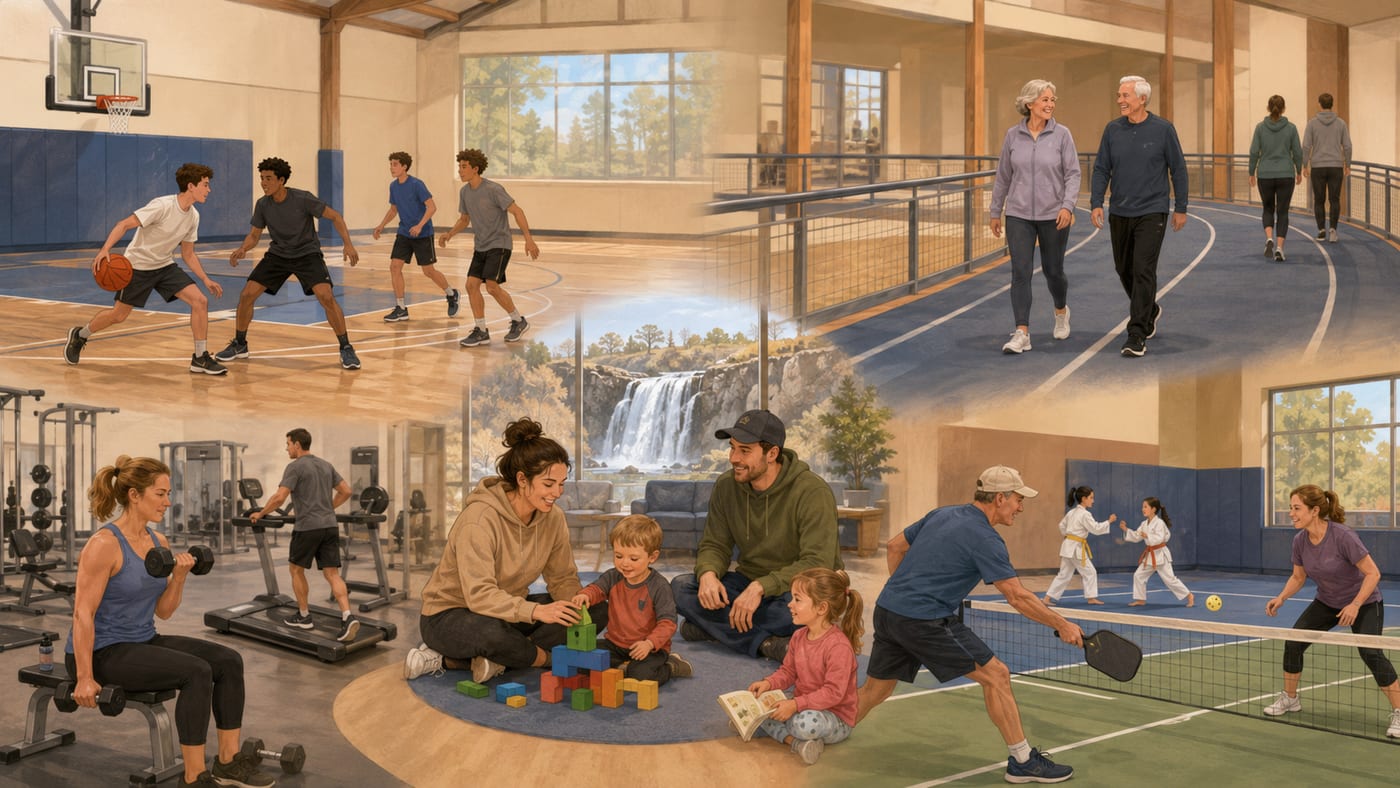
Inside, the gymnasium is running open family gym time. A dad and his two daughters are shooting baskets on one court. Another family is playing badminton on a portable net set up at the far end. A group of teenagers is running a half-court pickup game. A mom is walking the indoor track with a stroller while her toddler naps.
Nobody scheduled this. Nobody organized it. The facility is simply open, and people came because it is January in Twin Falls and there is finally somewhere to go.
This is the night that does not show up in an economic impact study or a tournament revenue projection. It is the night that shows up in how a city feels to live in.
Saturday, 9:00 a.m.
The facility is hosting a community cheerleading showcase in the gymnasium. Eight local rec center cheer teams, ages 6 through 14, are performing routines they have practiced for six weeks. The bleachers are packed with parents, grandparents, and siblings. Someone brought a sign. Several people are recording on their phones. A 7-year-old in a ponytail is nervously bouncing near the staging area.
In the multipurpose room, a table tennis tournament is running a 16-player round-robin. It started at 9 and will finish by noon. Entry fee was $5.
On the dedicated courts, a pickleball clinic for beginners is running its Saturday morning session. Eight people who have never played before are learning the basics from a volunteer instructor.
Three events. Three rooms. One Saturday morning. None of them required outside visitors or hotel bookings. All of them are Twin Falls residents using a facility their community built for itself.
Saturday, 2:00 p.m.
The cheer showcase is over. The gymnasium has been reset. A youth futsal league is playing afternoon matches. The multipurpose room is hosting a birthday party. The fitness center is steady with weekend drop-ins. The indoor track has its usual afternoon walkers.
A family of four walks in. The dad scans his membership card. The 10-year-old heads to the open gym court. The 7-year-old asks to go to the climbing wall. The mom heads to the fitness center. The dad takes a seat in the lobby, pulls out his phone, and waits. He will rotate through in an hour.
They will be here for two and a half hours. The membership covers all of it. Last year, this Saturday would have cost them a private gym day pass for the parents, a separate activity fee for the kids, and a 20-minute drive to Jerome for anything involving a pool or indoor court. This year it costs them nothing beyond the monthly membership they already pay.
That is what a rec center does on a Saturday. Not in theory. In practice.
Sunday
The building is open. Reduced hours. The fitness center runs. The indoor track is available. Open gym operates in the afternoon. A few pickleball regulars show up for casual play. A yoga class runs in the multipurpose room at 10.
It is quiet compared to Saturday. That is fine. The building does not need to be full every hour to justify itself. It needs to be available. It needs to be open. It needs to be the place that Twin Falls residents know is there when they want it, whether that is a packed tournament Saturday or a quiet Sunday afternoon walk.
What this adds up to
One week. One building. A 6 a.m. fitness class and a 7 p.m. dodgeball league. A teenager's after-school pickup game and a retired couple's morning walk. A martial arts class that costs $40 and a cheer showcase that fills the bleachers. Pickleball at dawn and futsal in the afternoon. Table tennis in the multipurpose room and a birthday party down the hall.
None of it requires a research citation. All of it requires a building.
The 22 posts that came before this one made the case with data, evidence, and documented examples from cities across Idaho and the country. This post makes the case with a Monday morning, a Wednesday after school, and a Saturday that a Twin Falls family actually wants to have.
Where the conversation stands
A recreation center committee within the Twin Falls Parks and Recreation Department has been studying this question since 2017. In June 2025, the City Council voted to advance the long-stalled feasibility study. Parks and Recreation Director Wendy Davis said the council's vote "breathed a little bit of life into what I thought was a dying initiative."
A grassroots advocacy campaign has proposed naming a potential facility after U.S. Army Specialist Troy Carlin Linden, a soldier with the 54th Engineer Battalion who was killed in action on July 8, 2006, in Ar Ramadi, Iraq. The proposal comes from a Twin Falls resident who served in the same unit.
Closing
Every argument for a Twin Falls recreation center comes down to the same thing: a building that is open when people need it, affordable enough that families actually use it, and programmed broadly enough that it serves the full community rather than a single slice of it.
This post did not cite a single study. It did not quote a federal agency or a peer-reviewed journal. It described a week. And if that week sounds like something you want for your family, your parents, your kids, or yourself, then you already know what 22 blog posts worth of research has been trying to say.
Twin Falls is ready for this. The question is whether this is the year the city decides to build it.
Frequently Asked Questions
How much does a rec center membership typically cost for a family? At comparable Idaho facilities like the Nampa Recreation Center, a family membership covers two adults and all dependent children for one flat monthly rate. Youth memberships run approximately $33 per month. Exact pricing for a Twin Falls facility would depend on the final design and programming scope.
Can you really use the rec center every day on one membership? Yes. Memberships at comparable facilities provide unlimited access to the fitness center, indoor track, open gym, and most drop-in programming. Specialty classes, camps, and some programs may carry small additional fees. But the daily use described in this post (morning fitness class, after-school open gym, weekend family time) is standard at facilities like Nampa's.
What about after-school access for teenagers? Open gym hours in the afternoon are a standard feature at community recreation centers. Students check in with an ID or membership card and have access to courts, the track, and common areas. This provides a supervised, active environment during the 3 to 6 p.m. window when many parents are still at work.
Is this what it actually looks like at other rec centers? Yes. The week described in this post is modeled on standard programming at the Nampa Recreation Center, the Jerome Recreation District, and comparable facilities in Pocatello and Idaho Falls. Nothing described here is hypothetical. It is what these facilities do every week.
Is Twin Falls actively considering a recreation center? A city committee has been studying the question since 2017. In June 2025, the City Council voted to advance the feasibility process. No specific site, cost, or funding mechanism has been finalized as of this writing.
Where can residents follow the conversation? Twin Falls City Council meetings are open to the public, and the Parks and Recreation Department posts updates on the city's official website. A community advocacy group is also tracking the issue at twinfallsreccenter.com.